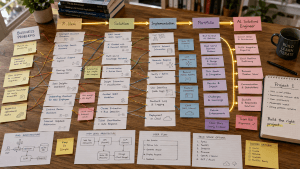
Career Dashboard
Current Target Role: Solutions Engineer (FinTech / Enterprise SaaS)
Original Time-to-Hire Estimate: 90–120 days
Current Time-to-Hire Estimate: 100–120 days
Confidence Level: Medium
Remaining Skill Gaps:
- AWS Certification formal completion
- API specification tooling (Postman/Swagger)
- Live Pitching mechanics
Weekly Review
Pace vs. Plan Audit: I am officially lagging behind my initial timeline expectations, and the culprit is an internal execution trap: over-studying. This week, I poured roughly 28 out of my 40 available hours deeply into technical research and cloud architecture whitepapers. While my theoretical knowledge is spiking, my outbound job-seeking execution has completely stalled. I have sent zero formal applications over the past four days because I felt “unprepared” without the physical certification badge in hand. This is a classic mid-career defense mechanism—using endless learning as a psychological shield to avoid the friction and potential rejection of the live job market. I am still completely committed to the Solutions Engineering track, but I must aggressively rebalance my daily 8-hour blocks next week to force outward-facing market activity.
The reality of a self-directed career pivot is that some days just feel like a punch to the jaw. Today was one of those days. I sat down at 8:00 AM, poured a coffee, and launched my first full-length, timed AWS Solutions Architect practice exam. Two hours later, the testing engine spit out a failing score of 68%.
The diagnostic breakdown showed that while my core compute and storage answers were solid, I fell apart entirely on complex enterprise hybrid migration scenarios. Questions involving the AWS Schema Conversion Tool, Database Migration Service (DMS) replication loops, and virtual private gateway routing architectures left me guessing. It turns out that knowing how to spin up an isolated EC2 instance or configure an S3 bucket is a world away from deciphering how a legacy Oracle database on-premise should continuously stream data to a cloud-native database without interrupting a live financial system.
Compounding the academic frustration, my networking pipeline has entered a phase of absolute silence. Out of the 10 tailored LinkedIn messages I sent last week to local individual contributors working in the SaaS space, 7 remain completely unread, 2 profiles viewed my page without dropping a reply, and 1 sent a polite but empty automated note directing me back to their corporate careers portal. The cold outreach framework in 2026 is clearly suffering from extreme fatigue; tech workers are insulated and exhausted by the sheer volume of inbound requests from displaced professionals. The little green “active now” dots next to people’s profiles feel less like open doors and more like high-voltage fences.
What I Learned
- The Enterprise Migration Reality: I realized that mid-market and enterprise SaaS clients rarely operate on a clean slate. They possess massive, messy legacy on-premise infrastructure footprints. A modern Solutions Engineer cannot just know how to build a fresh cloud application; they must understand how to safely bridge legacy systems to the cloud without interrupting live operations. You are not selling a clean house; you are selling a complex renovation while the family is still living inside.
- The Inefficacy of Cold Messaging: My networking results show that asking peers to “jump on a quick call to learn about their journey” is a dead strategy. In a tight market, people protect their time fiercely. To get a response, my outreach needs to offer immediate technical or intellectual value, or target individuals whose explicit mandate is team expansion, such as hiring managers.
What I Studied
I spent the remaining 4 hours of my day performing an intensive post-mortem on every single question I missed in the practice exam. I cross-referenced the failures with official cloud documentation and specialized pre-sales training channels to understand the underlying structural logic.
To bridge my gaps in hybrid architecture and migration strategies, I heavily utilized the following resources:
- Practice Diagnostics: I broke down my exam metrics using the deep-dive answer guides provided on the Tutorials Dojo Blog, which is essential for understanding situational cloud exam traps.
- Video Architecture Breakdowns: I watched several enterprise case studies on the AWS Architecture Online YouTube Channel to see how real-world Solutions Engineers design hybrid environments using Transit Gateways.
- Technical Deep-Dives: I studied Adrian Cantrill’s architectural guides on his Cantrill.io Tech Blog to better visualize how data frames traverse a Direct Connect connection versus a standard internet-based VPN.
Skills Acquired
- AWS Enterprise Hybrid Network Design:
- What it is: The architectural design patterns used to link corporate on-premise infrastructure with public cloud environments using AWS Direct Connect, IPSec VPN tunnels, Storage Gateways, and managed data replication via AWS Database Migration Service (DMS).
- Why I decided to learn: This directly addresses a critical knowledge deficit exposed by my practice exam failure. It ensures I can intelligently discuss data ingestion and hybrid risk mitigation strategies with enterprise clients during high-stakes technical interviews.
- Further delve required?: Yes. I need to run a hands-on simulation of a database schema conversion using a local database engine to truly understand the operational friction points before I schedule the real exam.
Progress Against Plan
Behind Schedule. Because I failed the mock exam, I cannot risk spending the money on the official test voucher this week. I am extending my technical preparation phase by at least three days to drill my weak spots, which pushes my active application timeline further down the road. My original goal was to be fully certified by Day 15; that is now pushed to Day 18.
Strategy Changes
- The Pivot: Ceasing cold outreach to mid-level individual contributors who have no say in the budget. I am shifting my networking target directly to Technical Account Managers (TAMs) and Solutions Engineering Managers. My outreach will switch to a concise, three-sentence message focusing specifically on how my 11-year financial systems background solves their immediate team integration pains, rather than asking for vague “career advice.”
Next Step
Tomorrow will be a focused technical drill. I will spend the first 4 hours constructing mock network topologies on paper to build muscle memory, followed by a deep-dive into AWS IAM policy evaluation logic and role assumptions using the AWS Security Blog.
Reflection
Sitting at a desk for 8 hours trying to memorize complex network routing protocols while my two-year-old daughter laughs and plays in the adjacent room is a unique mental test. It is easy to let self-doubt creep in at 41 when the numbers don’t go your way and the screen flashes red. But the market doesn’t care about my feelings or my past titles; it cares about precision. I failed the mock test today, but I now know exactly where my blind spots are. I will master these migration protocols tomorrow.