Career Dashboard
Current Target Role: AI Solutions Engineer
Original Time-to-Hire Estimate: 3–6 Months
Current Time-to-Hire Estimate: 3–5 Months
Confidence Level: Medium
Remaining Skill Gaps:
- Demonstrable AI project experience
- Cloud deployment experience
- Portfolio evidence
- Interview readiness
- Stronger positioning for target roles
Progress Since Day 1:
✓ Established a structured learning plan
✓ Identified transferable skills from previous roles
✓ Developed a clearer understanding of modern AI architecture
✓ Started connecting individual technologies into larger solution patterns
✓ Increased confidence in the relevance of existing product and technical experience
Today’s Question
Am I actually learning something completely new, or am I learning a new version of something I’ve already seen before?
That question came to mind repeatedly this week as I continued exploring AI agents, orchestration frameworks, and enterprise AI architectures. A few weeks ago, every concept felt unfamiliar. Today, something different happened.
The technologies still feel new. The patterns do not.
What I Worked On
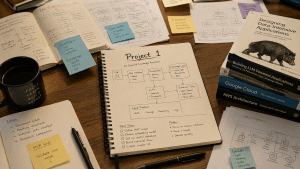
Over the last several days, I spent time reviewing how enterprise AI systems are assembled. My focus wasn’t on individual models or tools. Instead, I wanted to understand how the different components interact.
Topics I explored included:
- AI agents
- Workflow orchestration
- Tool calling
- Memory management
- Multi-step reasoning workflows
- Enterprise AI architecture patterns
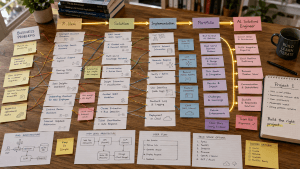
As I reviewed architecture diagrams and implementation examples, I found myself making comparisons to systems I’ve worked with throughout my career.
| AI Systems | Enterprise Systems |
|---|---|
| AI agents often need access to multiple tools and services. | Enterprise applications frequently integrate with multiple internal and external systems. |
| Agent workflows require orchestration to coordinate tasks and decision-making. | Enterprise platforms require orchestration to manage business processes and system interactions. |
| AI solutions depend on memory, context, and data retrieval mechanisms. | Enterprise systems depend on databases, data management, and information workflows. |
| AI systems require monitoring to ensure accuracy, performance, and reliability. | Enterprise systems require monitoring to ensure availability, performance, and reliability. |
| AI deployments need governance, security, and compliance controls. | Enterprise platforms need governance, security, and compliance controls. |
| AI solutions are ultimately designed to solve business problems. | Enterprise systems are ultimately designed to solve business problems. |
Even concepts like memory management started reminding me of data management challenges I’ve encountered in other environments. The terminology may be different, but many of the underlying concerns remain the same. This realization has reduced some of the intimidation I initially felt.
Instead of feeling like I’m starting from zero, I’m beginning to recognize that years of experience solving technology and business problems still matter.
Resources Reviewed
This week focused heavily on architecture and implementation concepts rather than specific technologies.
Documentation
- LangChain Agents Documentation
- LangGraph Documentation
- Google Cloud Architecture Center
- Microsoft Azure Architecture Center
Architecture Topics
- AI Agents
- Workflow Orchestration
- Tool Calling
- Multi-Agent Systems
- Enterprise AI Architecture
Learning Focus
Understanding how AI components collaborate to solve business problems rather than studying individual tools in isolation.
Progress Against Plan
One of my biggest concerns at the start of this journey was whether my previous experience would remain relevant in an AI-driven industry.
Two and a half weeks later, I’m feeling more optimistic than I expected. I still have significant gaps to address, including building projects, gaining cloud deployment experience, strengthening my portfolio, and preparing for interviews. Those priorities haven’t changed.
What has changed is my perspective. I’m starting to see this transition as more than just learning new technologies. It’s also about recognizing where my existing experience applies. The more enterprise AI architectures and solution patterns I review, the more familiar many of the underlying challenges seem.
There’s still plenty of work ahead, but the path forward feels much clearer than it did on Day 1.
Strategy Changes
My learning strategy continues to evolve. Earlier in this journey, I focused heavily on technologies. Then I shifted toward understanding problems. Now I’m adding a third layer.
I’m actively looking for patterns. Whenever I encounter a new concept, I ask:
- Have I seen something similar before?
- What business problem is being solved?
- What existing experience can help me understand it faster?
This approach has dramatically improved retention. More importantly, it has made the learning process feel less overwhelming.
Next Steps
Over the next few days, I want to shift from architecture concepts toward practical implementation.
My goals include:
- Identifying portfolio project ideas
- Evaluating deployment options
- Exploring cloud-based AI solutions
- Understanding common AI solution patterns
At some point, learning must transition into building. I think I’m approaching that point.
Reflections
One assumption I had at the beginning of this journey was that the AI industry represented a complete reset. I imagined years of previous experience becoming less relevant as entirely new technologies emerged.Today, I don’t think that’s true.
While the tools and technologies are evolving at an incredible pace, many of the underlying challenges remain surprisingly familiar. Organizations still need reliable and scalable systems. They still need governance, integration, operational oversight, and clear connections between technical capabilities and business outcomes.
What has changed is not the existence of these challenges, but the technologies available to address them.
That realization has been one of the most encouraging discoveries of this journey so far. When I started, I was focused almost entirely on the gap between my current skills and the roles I hoped to pursue. Three weeks later, I’m beginning to pay more attention to the experience, knowledge, and problem-solving approaches that already transfer into this new landscape.
There is still a great deal to learn, but the path ahead feels less like starting over and more like building on a foundation that already exists.