Career Dashboard
Current Target Role: Cloud / DevOps Engineer (primary); AI‑adjacent Platform Engineer / MLOps (secondary)
Original Time-to-Hire Estimate: 3–6 months
Current Time-to-Hire Estimate: 3–6 months
Confidence Level: Medium
Skills Acquired: Inventory and conceptual understanding of Terraform, Docker, AWS fundamentals, and CI/CD.
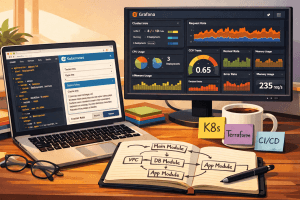
Remaining Skill Gaps: Kubernetes orchestration, advanced Terraform patterns, managed cloud services (EKS/GKE), observability tooling (Prometheus/Grafana), security hardening, and practical MLOps basics.
Today’s Objective
Today I paused long enough to build a realistic, evidence‑based plan that optimizes for employability. The aim was to translate eleven years of mixed software, support, and product experience into a short list of high‑leverage technical skills hiring managers actually test for, then design a 12‑week sprint that fits an eight‑hour‑per‑day maximum while balancing family responsibilities.
What I Worked On
I performed three concrete tasks: a market scan of representative job postings to extract recurring skill language, a skills inventory mapping past responsibilities to concrete technical and soft skills, and a prioritization exercise to choose a primary target role. I sketched a portfolio project that demonstrates the core competencies employers ask for—Infrastructure as Code, containerization, CI/CD automation, and basic observability—and planned how to document troubleshooting stories from past production incidents for interviews.
What I Learned
The most important insight was that hiring managers are pragmatic. They want engineers who can keep systems running, automate repeatable tasks, and ship reliable infrastructure. Pure research AI roles are plentiful but often require specialized ML experience or advanced degrees. In contrast, cloud and DevOps roles reward operational experience and demonstrable IaC/CI/CD skills—areas where my background maps well. Adding a small AI‑adjacent capability increases marketability without derailing the faster path to hire.
Skills Acquired — Definitions, Usage, and Why They Matter
- Terraform Infra Repo
What it is: Terraform is an Infrastructure as Code (IaC) tool that lets you declare cloud resources—networks, virtual machines, storage, IAM policies—in human‑readable configuration files. A Terraform infra repo is a versioned codebase containing those configuration files, modules, and state management patterns.
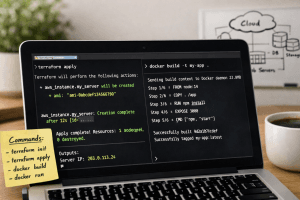
How it’s used: You write.tffiles to describe desired infrastructure, runterraform planto preview changes, andterraform applyto enact them. State files track what’s been provisioned so future changes are incremental and auditable.
Why it’s worth learning: IaC is the lingua franca of modern infrastructure teams. Employers want reproducible, auditable deployments; a Terraform repo demonstrates you can codify infrastructure, reason about state and drift, and collaborate on infra changes via Git. For someone with production support experience, Terraform converts operational knowledge into artifacts hiring managers can validate quickly. - Docker Containerization
What it is: Docker packages an application and its dependencies into a container image that runs consistently across environments. A Dockerfile defines how to build that image.
How it’s used: Developers build images locally, run containers for testing, and push images to registries for deployment. Containers are the unit that orchestration systems (Kubernetes, ECS) schedule.
Why it’s worth learning: Containers are the standard deployment unit for cloud‑native apps. Knowing Docker proves you understand packaging, dependency isolation, and the first step toward orchestration. It’s a practical skill interviewers test with simple tasks or questions. - AWS Fundamentals
What it is: Practical knowledge of a major cloud provider—provisioning compute, storage, networking, and IAM; understanding managed services and cost implications.
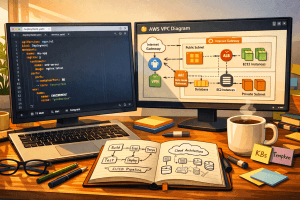
How it’s used: You create VPCs, EC2 instances, S3 buckets, and configure IAM roles and policies. You reason about availability, security, and cost tradeoffs.
Why it’s worth learning: Most cloud/DevOps roles expect familiarity with at least one major cloud. AWS remains widely used; demonstrating you can provision resources and reason about permissions and costs is high leverage. - CI/CD Concepts (GitHub Actions / GitLab CI / Jenkins)
What it is: Continuous Integration and Continuous Deployment are practices and pipelines that automatically build, test, and deploy code changes.
How it’s used: Pipelines run on commits or PRs to build artifacts, run tests, and deploy to staging/production. They enforce quality gates and reduce manual steps.
Why it’s worth learning: CI/CD is how teams ship reliably. A working pipeline in a portfolio proves you can automate repetitive tasks, integrate testing, and reduce human error—skills that directly impact team productivity.
Market Observations
Across job postings, three themes repeated: Kubernetes and container orchestration are baseline expectations for mid‑level infra roles; Terraform and cloud provider experience are frequently listed as required or strongly preferred; and observability and incident response experience are differentiators. MLOps/platform roles prefer engineers who can bridge infra and model deployment, but those roles often expect prior ML exposure.
Resources Reviewed
I reviewed representative job postings, official cloud quickstarts, and Terraform getting‑started guides. I chose canonical sources because hiring managers often phrase requirements using provider terminology; aligning my learning to that language reduces friction in interviews.
Progress Against Plan
On track. The baseline assessment and role selection are complete, and the 12‑week sprint is drafted. I prioritized a single, achievable portfolio project that demonstrates IaC, CI/CD, containerization, and observability.
Strategy Changes
None yet. The plan remains to pursue Cloud/DevOps as the primary path while building a small AI‑adjacent artifact to increase appeal for platform or MLOps roles.
Next Steps
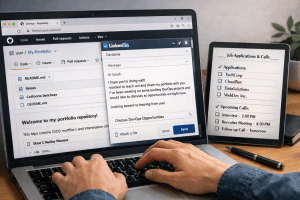
Start hands‑on labs: pick AWS as the primary cloud, complete Terraform basics, containerize a small service, and create a GitHub Actions pipeline. Document everything in a public repo and prepare a concise README and a 5‑minute walkthrough video.
Reflection
It’s tempting to chase the most exciting path, but the fastest route back to steady employment is to play to strengths and fill the smallest number of high‑value gaps. My production support and client communication experience are assets; the work now is to convert that into demonstrable cloud and automation skills that hiring managers can validate in a 30–60 minute screening.