Career Dashboard
Current Target Role: Cloud / DevOps Engineer (primary); Platform / MLOps Engineer (secondary)
Original Time-to-Hire Estimate: 3–6 months
Current Time-to-Hire Estimate: 3–5 months
Confidence Level: Medium
Skills Acquired: Hands‑on completion of AWS free‑tier tasks, a small Terraform repo, and a Dockerized microservice.
Remaining Skill Gaps: Kubernetes cluster management, advanced Terraform patterns, CI/CD pipeline complexity, observability stack, cloud networking, security hardening.
Today’s Objective
Turn planning into momentum by starting practical labs that will form the backbone of the portfolio project and the interview talking points. The goal was to produce reproducible artifacts I can point to in conversations and to capture troubleshooting stories that demonstrate operational judgment.
What I Worked On
I spent the day in hands‑on mode. I set up an AWS account, provisioned a small EC2 instance and an S3 bucket, and then codified that infrastructure using Terraform. I wrote a Dockerfile for a simple Python microservice, built the image locally, and ran it in a container. I kept detailed notes on commands, errors, and troubleshooting steps to use as interview material.
What I Learned
Two practical lessons stood out. First, the friction points are predictable: IAM permissions, Terraform state handling, and container networking are where interviews often probe. Second, documenting the troubleshooting process is as valuable as the final working system. Recruiters and hiring managers ask for examples of incidents and how you resolved them; having a concise, reproducible example from my labs will be useful.
Skills Acquired — Practical Details and Why They Matter
- Terraform Practical Use (Applied)
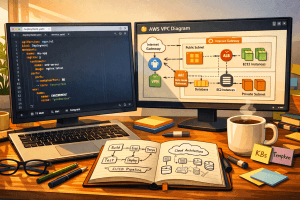
What I did: I created a small Terraform repo that defines an S3 bucket and an EC2 instance, initialized the workspace, ranterraform plan, and applied the changes. I inspected the state file and practiced destroying resources to avoid costs.
Why it matters: This shows the full IaC lifecycle—write, plan, apply, and destroy—and demonstrates awareness of state and cost management. Interviewers often ask about state locking, remote backends, and modularization; having a working repo lets me answer with concrete examples. - Docker Local Development (Applied)
What I did: I wrote a Dockerfile for a Python Flask service, built the image, ran the container locally, and pushed the image to a container registry. I also experimented with environment variables and volume mounts.
Why it matters: This proves I can package and run services consistently across environments. It’s the first step toward deploying to Kubernetes or a managed container service. - AWS Hands‑On (Applied)
What I did: I provisioned basic resources, configured IAM roles with least privilege for the demo, and practiced cleaning up resources to avoid unexpected costs.
Why it matters: Practical cloud experience shows I can navigate provider consoles, understand billing implications, and reason about permissions—skills hiring managers test in interviews.
Market Observations
Job descriptions often include “experience with Terraform” and “containerization” as must‑haves. Employers expect candidates to explain tradeoffs (for example, when to use ECS vs. EKS or how to structure Terraform modules). This confirms that hands‑on practice is aligned with what hiring teams evaluate.
Resources Reviewed
I used official AWS quickstarts, the Terraform docs, and a Docker tutorial. I chose these because they are canonical and reduce ambiguity when explaining decisions in interviews.
Progress Against Plan
Slightly ahead. Completing two foundational labs early gives buffer time to start Kubernetes basics sooner and to iterate on the portfolio.
Strategy Changes
None yet, but I committed to a single cloud provider (AWS) to avoid spreading effort too thin and to make the portfolio coherent.
Next Steps
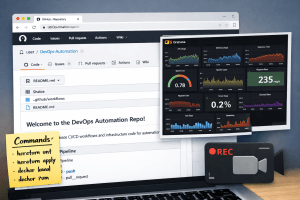
Begin Kubernetes basics with a local single‑node cluster (kind or minikube), deploy the containerized service to it, and push the Terraform + Docker artifacts to a GitHub repo with a clear README and troubleshooting section.
Reflection
Early hands‑on wins are motivating. The key is to keep scope small and demonstrable: a single service deployed with IaC, automated with CI, and observable with basic metrics will be more persuasive than an overambitious AI project that remains incomplete. I’m building evidence, not just learning for learning’s sake.