Career Dashboard
Current Target Role: Cloud / DevOps Engineer (primary), Platform / MLOps Engineer (secondary)
Original Time-to-Hire Estimate: 3–6 months
Current Time-to-Hire Estimate: 3–5 months
Confidence Level: Medium
Skills Acquired: Kubernetes Deployments & Pods, ConfigMaps & Secrets, AWS VPC Fundamentals, CI/CD Security & Linting
Remaining Skill Gaps:
- Managed Kubernetes (EKS/GKE)
- Deeper networking (NAT gateways, IGWs)
- IAM policies
- Grafana dashboards
- Interview readiness
Today’s Objective
Today’s objective was to run a Mid‑Week Progress Check and evaluate whether the weekly plan is still realistic. The plan for this week included:
- Deepening Kubernetes knowledge
- Starting AWS networking fundamentals
- Preparing for screening calls
- Applying to more roles
The goal wasn’t to finish everything but to understand whether the direction and pace are sustainable.
What I Worked On
I divided today’s work into three major blocks: Kubernetes troubleshooting, cloud networking fundamentals, and job search preparation.
1. Kubernetes Troubleshooting
I spent the morning debugging a NodePort issue. My service wasn’t reachable, and after checking logs, events, and YAML definitions, I found the culprit: a mismatch between the container port and the service targetPort. Kubernetes errors often hide behind layers of abstraction, so this was a good reminder to check the basics first.
I practiced:
- Scaling deployments
- Triggering rolling updates
- Using
kubectl rollout status - Inspecting ReplicaSets
- Checking pod logs with
kubectl logs
These exercises helped me understand how Kubernetes handles state transitions and why declarative systems require a different mindset.
2. Cloud Networking Fundamentals
In the afternoon, I reviewed AWS VPC basics. I watched a short AWS VPC tutorial and drew diagrams to visualize how subnets, route tables, and gateways interact.
Key concepts I practiced:
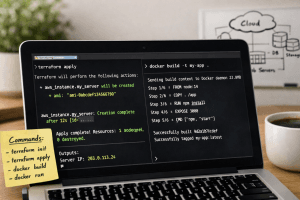
- Creating a VPC with Terraform
- Adding public and private subnets
- Understanding NAT vs. Internet Gateways
- Configuring route tables
- Writing security group rules
This is foundational knowledge for EKS, where networking is often the hardest part.
3. Job Search Preparation
I reviewed DevOps interview questions from DevOpsCube and wrote two STAR stories based on real incidents from my previous job. I also updated my resume to highlight my Kubernetes work.
I applied to three more roles and received one recruiter reply asking for availability next week.
What I Learned
Today I learned that Kubernetes is starting to feel less foreign. The YAML still feels verbose, but I’m beginning to understand how the pieces fit together. I also learned that cloud networking is more intuitive when visualized—drawing diagrams helped more than reading documentation.
Another important lesson: job search progress is unpredictable. Some days bring replies, others don’t. The key is consistency, not volume. Preparing STAR stories early reduces anxiety before screening calls.
Skills Acquired (with definitions + why they matter):
- Kubernetes Deployments & Pods I now understand how Kubernetes maintains desired state using Deployments and ReplicaSets. Pods are the smallest deployable units, and learning how they restart, scale, and fail is essential for DevOps interviews.
- ConfigMaps & Secrets ConfigMaps store non-sensitive configuration, while Secrets store sensitive values like API keys. This matters because real-world deployments rarely hardcode environment variables.
- AWS VPC Fundamentals I began learning how subnets, route tables, NAT gateways, and Internet Gateways define traffic flow. This is foundational for EKS, where networking is often the hardest part.
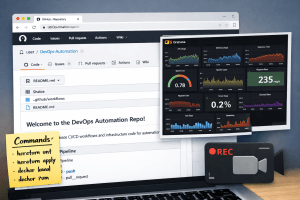
- CI/CD Security & Linting I added
flake8andbanditto my GitHub Actions pipeline to enforce code quality and security checks. This demonstrates awareness of secure DevOps practices. Ref: Bandit Security Scanner
Market Observations
I reviewed about 15 new job postings today. The patterns remain consistent:
Common Requirements
- Kubernetes (EKS/GKE preferred)
- Terraform
- CI/CD pipelines
- AWS or GCP
- Docker
Nice‑to‑Haves
- Prometheus/Grafana
- GitOps (ArgoCD)
- SRE practices
- Python scripting
Occasional Mentions
- MLOps
- Model deployment
- Feature stores
This reinforces that my current learning path is aligned with market demand.
Resources Reviewed
- TechWorld with Nana – Kubernetes Debugging (CrashLoopBackOff Debugging)
- AWS VPC Basics AWS VPC Tutorial
- DevOps Interview Questions DevOpsCube
- Terraform VPC Module Examples Terraform AWS VPC Module
Progress Against Plan
Ahead On
- Kubernetes debugging
- Cloud networking fundamentals
- STAR story preparation
On Track For
- Applying to more roles
- Improving portfolio documentation
Behind On
- Grafana dashboards
- Managed Kubernetes (EKS)
- Deep IAM knowledge
Overall, I’m slightly ahead of where I expected to be by mid‑week.
Mid‑Week Progress
This mid‑week check shows that the plan is working, but the pacing needs small adjustments. Kubernetes is taking more time than expected, but the progress feels meaningful. Cloud networking is a bigger topic than I anticipated, but it’s foundational for EKS, so the time investment is justified.
Should I continue with the weekly plan? Yes.
Should I adjust anything? Yes—shift Grafana to next week and focus on Kubernetes + networking for the rest of this week.
Strategy Changes
No major pivots. I’m keeping the same direction but adjusting the timeline:
- Delay Grafana dashboards
- Delay EKS until networking feels solid
- Continue focusing on Kubernetes fundamentals
Next Steps
Over the next few days, I plan to:
- Deploy my service using a Kubernetes Ingress
- Add liveness/readiness probes
- Continue VPC Terraform work
- Prepare for the upcoming recruiter call
- Apply to 3–5 more roles
If time allows, I’ll also start experimenting with Helm charts.
Reflection
Today felt productive but grounded. I’m starting to see how the pieces—Terraform, Docker, Kubernetes, CI/CD, networking—fit together into a coherent DevOps skill set. It’s still overwhelming at times, but the progress is real. The job search is slowly gaining traction, and the technical foundation is getting stronger. The key now is consistency, not speed.